Recent Ruins / Catalogue / Wood
Mantels
| Period range | 1850-1930 |
|---|---|
| Usual fabric | Pine, oak, marble, slate, cast iron |
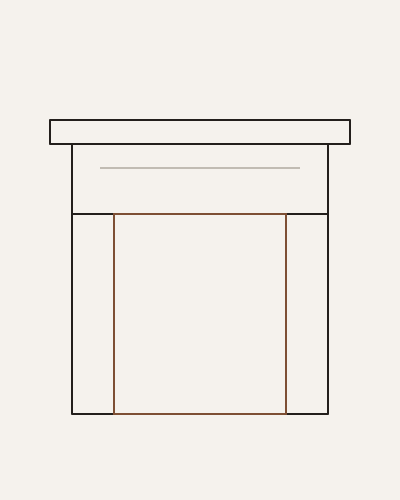
| Usual form | Shelf, frieze and two legs around a firebox opening |
| Wear to expect | Split legs, scorched inner edges, stripped and re-stripped paint |
A mantel is measured from the opening outward, and an inch of error at the firebox is an inch that cannot be made up anywhere else on the piece.
What it is
Most surviving mantels are painted softwood, built as a shelf and frieze carried on two legs, with the whole assembly designed to stand proud of a firebox opening. Marble and slate mantels are heavier, usually earlier in feel, and often carry a painted finish on the slate imitating a stone the maker did not have. Cast-iron inserts and summer covers are a separate class of object that sit inside the opening rather than around it.
How to tell age
Construction tells more than ornament, because ornament was copied continuously. Hand-cut mouldings vary along their length; machine-run mouldings do not. Look inside the legs for saw marks, and at the back of the shelf for the nails: cut nails with a rectangular section are earlier than round wire nails. A mantel assembled with screws through plugged holes has usually been apart at least once.
What commonly fails
Legs split along the grain where they were nailed too close to an edge, and the split usually opens further every time the piece is moved. Composition ornament shrinks and lifts away from its ground. On marble, the failure is a clean break at the shelf corners, which is repairable but always visible in raking light.
What to check before fitting
Take the firebox opening height and width, then the overall wall space, then the depth of the projection you can live with. A mantel that suits the opening but stands too proud for the room reads wrong from the doorway. Check the back for a level bearing surface, and check that the legs are the same length, because they frequently are not.